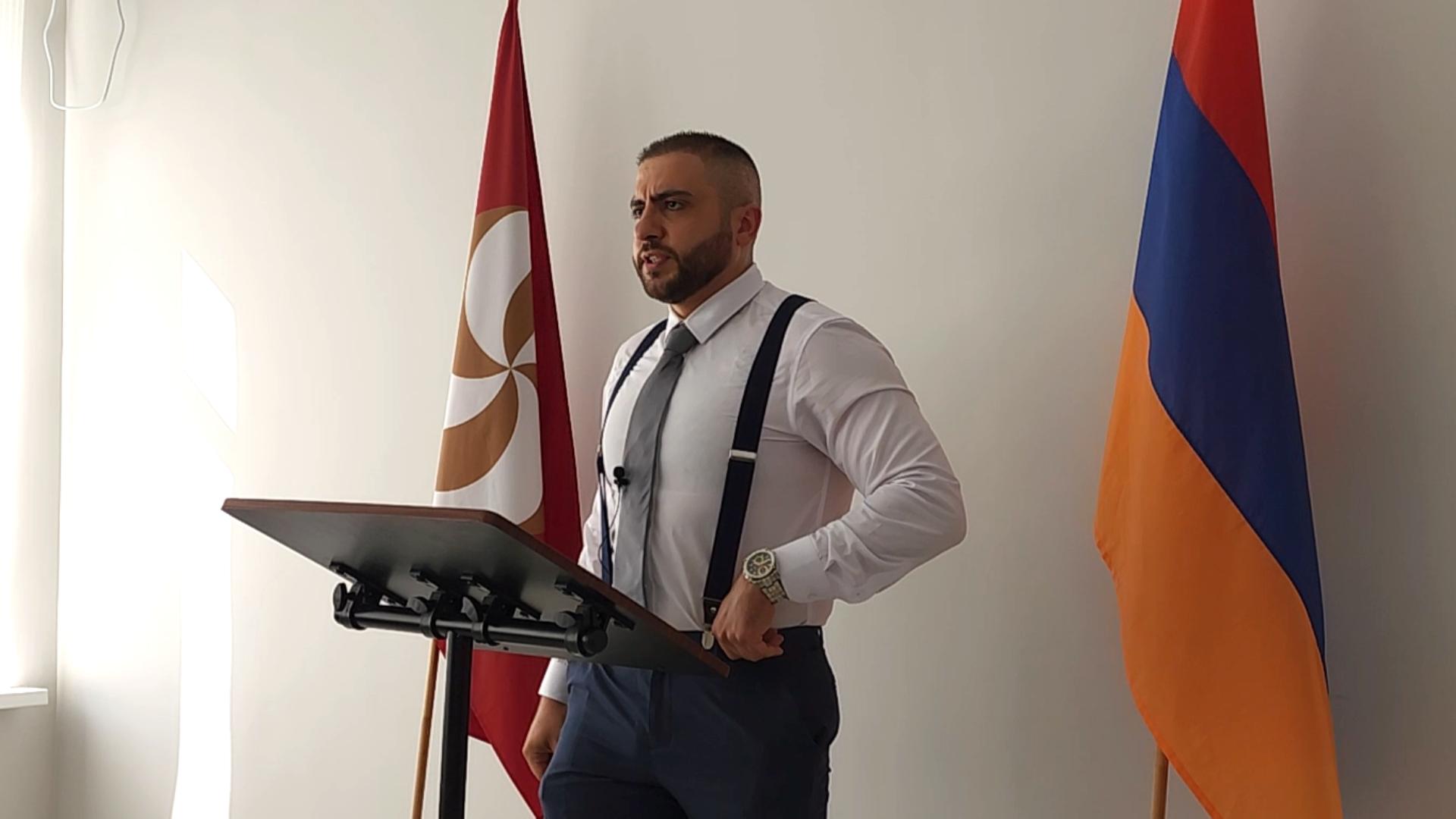
Hayk Nazaryan - Speech #11 with subtitles - At the meeting (10-08-2025)
03:00:00 10.08.2025
Speech #11
At the Meeting
If you have listened to my speeches and conducted your own appropriate research, I believe you are already convinced that the so-called “opposition,” together with the authorities, committed a great betrayal during the war and continues to do so afterward. I think it is already clear what they meant when, from the very beginning of the war, they called for stopping it, and after the war, blamed the authorities not for surrendering, but for surrendering late. All of this was not random statements or accusations; it was part of a much larger anti-Armenian plan. Such an opposition, naturally, can never be considered national, because their calls are not merely unpatriotic—they are explicitly anti-national.
During the war, the false “opposition” deliberately misled our compatriots with such calls, while the authorities did so in a more covert manner. The authorities propagated the idea of “we will triumph,” which is, in fact, a reasonable and logical slogan for a nation at war. The problem, however, is that under this slogan there was no substance. They spread “we will triumph,” but in reality, they had already prepared our defeat in advance. Through external and internal arrangements, they did everything to ensure we would lose that war and suffer heavy losses.
Let us start with the simplest question: what exactly did they mean when they said “we will triumph”? The issue, as I have already stated, is not in the slogan itself, but in the fact that those spreading it had neither the goal nor the intention to win. Even if we assume that they truly had the will to triumph and that not everything was pre-planned, the question would still arise: how was that victory defined? The government, which propagated the slogan “we will triumph,” never clearly told the people what specifically or what kind of victory was expected.
For example, in the First Artsakh Liberation War, we achieved military success and victory by liberating Artsakh from the Turks and Azerbaijani armed forces because we had set such a goal from the beginning. Unfortunately, we did not solidify it politically on paper due to internal agents operating in Armenia. If we had not had such a clear goal in our minds and plans, we could never have achieved it.
Unfortunately, in this recent treacherous war, there was neither a military nor a political goal. What would winning have meant for us? The majority of our compatriots cannot answer this question, even those who consider themselves intellectuals or nationalists. Was winning reaching Baku, or just retaining the territory of the NKR, or—as many reasonable nationalists believe—crushing the Azerbaijani army and uniting all of Artsakh, including Northern Artsakh, with the Republic of Armenia as one unified state.
Victory would have meant finally resolving the so-called Artsakh issue in a purely Armenian way and moving forward, focusing on the liberation of Nakhchivan. Had the Artsakh issue been resolved in the correct, national way, I am confident that liberating Nakhchivan would not have required much effort, because in that case, Azerbaijan would likely have fractured internally and divided into several parts. This was an opportunity for us to complete the task left unfinished in 1994. But again, due to internal betrayal, it did not happen.
The fact that our political elite had neither military nor political goals tells us one thing: our government and generals were either so incompetent and foolish, or they had no intention whatsoever of setting any goal, because this war was prearranged, and they deliberately led us to defeat—stabbing our army in the back. It is as if they deliberately said “we will triumph” in order to later take away our will to fight and hope of victory. And for the most part, they succeeded, because the overwhelming majority of our compatriots no longer even think about fighting or winning. The loss of the will to fight and triumph is one of the greatest signs that our army and state are heading toward the abyss.
As I have noted several times—and I think it should be emphasized periodically—the present false “opposition” did not raise these questions during the war. Instead, from the first week, they said: “We must stop the war,” which indirectly meant immediate surrender and acceptance of Russian mediation. After the war, instead of asking logical and healthy questions like why we did not fight to the end and win, as we did 26 years ago in the Artsakh Liberation War, they asked: “Why didn’t we surrender sooner?” because “defeat was inevitable.”
Any genuine and national opposition would have raised the first type of questions if it were truly concerned with restoring the Armenian army and preserving our independence. We can assert without any doubt that the false “opposition,” together with the Pashinyan clan, constitutes the same neo-Bolshevik anti-Armenian network, which, as Kremlin puppets, directly or indirectly serve the interests of the Russo-Turkish-Zionist tandem. Our soldiers fought courageously and heroically on the front lines, while the neo-Bolsheviks in the government, general staff, and opposition struck them from behind.
A national state, from the very first day of the war, would have clearly defined its political and military goals, which would have exclusively served Armenia’s independence. That state would have thought not about how to end the war quickly, but about how to deliver the most powerful blows to the enemy forces in order to fully unite Artsakh with Armenia, politically cementing our military victory. In the presence of such a national state, defeat would not have been “inevitable,” as the fifth column propagates, but impossible, because the state would have had the same will to triumph that our freedom fighters had 30 years ago when liberating Artsakh.
If our political elite had long understood these extremely simple but profound ideas, they would have recognized the necessity of having the will to triumph. They would have also realized that, to win this last war, our armed forces needed to be reformed long ago—creating a truly Armenian army adapted to our psychology, geography, and essence, rather than copying another country’s military model.
If they truly had national thinking, they could have resolved the Artsakh issue—the most pro-Armenian way I mentioned—back in 1994, in just a few months. Instead, they cast doubt on our military victory and artificially complicated the Artsakh issue, presenting it as an unsolvable problem. Representatives of the anti-Armenian government and traitorous “former” opposition shamelessly talk constantly about patriotism and dignity, but in 26 years they could neither or would not unite the 10,000 km² of Artsakh liberated by our freedom fighters with Armenia. No justification will save them from future historical judgment.
From Jews son-in-law Levon Ter-Petrosyan onwards, ALL the leaders struck Artsakh and gradually brought us down from a victorious position into a dead end, leading to a humiliating defeat. One signed a ceasefire and did not recognize victory, another maintained the same anti-national status quo, the next pursued treacherous compromises, and the last delivered the final blow. They represented a victorious state but negotiated as if they were defeated leaders. Because of their anti-national diplomacy, we reached this disgraceful situation. This is natural, since nothing else can be expected from the heirs of Bolshevik Chekists.
They inherited a victorious state but, in 26 years, did not solve this small issue or did not want to. This is either total incompetence, simple treachery, or both. If they could bring a victorious state to this point, imagine what they will do governing a defeated state. Therefore, we must think soberly and realistically. We must follow the example of our freedom fighters, not the traitorous neo-Bolsheviks, if we want to know how to conduct a pro-Armenian strategy and policy.
We won the First Artsakh Liberation War because we conducted an active defensive and offensive war, taking the fight to the enemy. In the 44-day treacherous war, we lost because the enemy this time applied the same strategy against us, while we were merely in defensive positions. In other words, for over twenty years they studied how we had defeated them, and they used the same methods against us, while we did not learn or apply lessons from our victories in this last war. By fighting defensively only, we cannot retain our lands. That may be possible for large countries with vast territories, but for us, it is impossible.
This proves that, if we want to defend Syunik, we must have an offensive strategy, repeating the successful 1990s experience. We must learn lessons from our mistakes so that November 9, 2020, never repeats. Syunik must never share Artsakh’s fate.
And as ironic as it seems, over the past five years, the most encouraging words for us came from the dictator of Baku, who, about a year after the war, declared that they would not allow the Armenian army to become a threat to them again. This means they fully understand the potential we have. They know better than us that we can recover and pose a threat once again, because our enemies know us better than we know ourselves. They have more faith in our capabilities than we do. That is why they try to resolve everything quickly while they can. They know that when the Armenian nation awakens again, their days will be numbered.
Let us take all of this into account. Let us show our enemies that the Armenian nation can rise, that it can again become their fear and terror. To achieve this, we must eradicate from within the defeatist mindset of the authorities and false opposition, which manipulated us during and after the war.
Before breaking us physically, they broke us spiritually. Therefore, our first step must be the restoration of our fighting spirit. We can follow the path of victory if we regain the will to triumph and start believing in our potential again. Only by believing in our potential can we become a force to be reckoned with and solve all our problems, neutralizing all threats from the enemy.
No matter how times change or diplomacy develops, the laws of nature do not change. Force is the first law of nature. Force decides what is right. Force makes the world go round. Only through force is there vengeance, only through force is there victory, only through force is there the salvation of the Armenian people.
- Hayk Nazaryan
August 10, 2025