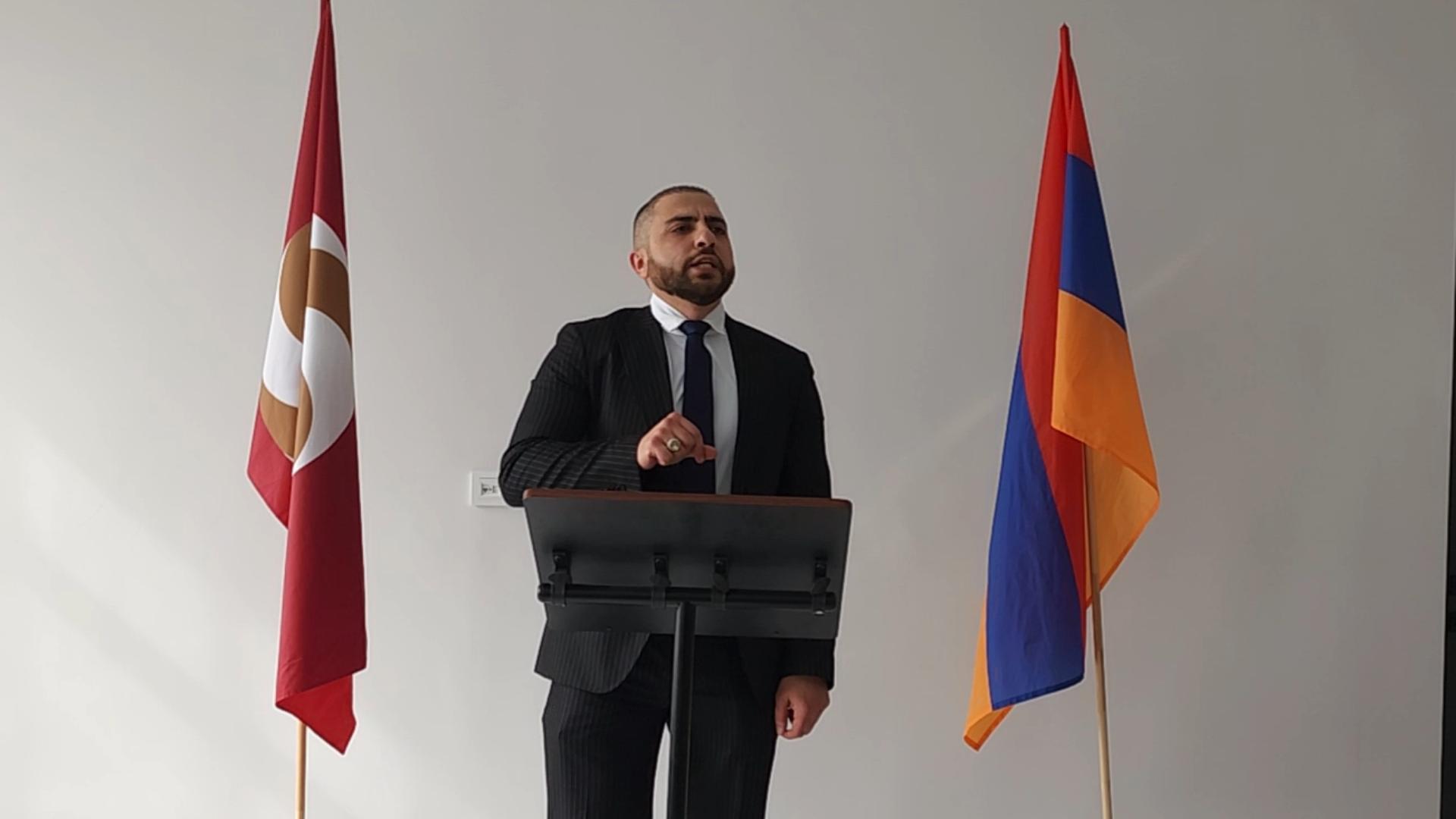
Hayk Nazaryan - Speech #7 with English subtitles (17-05-2025)
03:00:00 17.05.2025
Speech #7
Meeting
This year we marked the 110th anniversary of the Armenian Genocide—an atrocity that struck a seemingly irreversible blow to our nation. There is no Armenian in the world who is unaware of those horrific events, as they have negatively affected the fate of us all and introduced a deep fracture within the Armenian people. The Armenian Genocide is the darkest chapter of our modern history—an evident fact for all Armenians—but most of our historians fail to highlight an event that followed the Genocide, which had almost as devastating an effect on our national destiny.
That event was the defeat of our First Republic’s army in 1920, during a war unleashed by the Russo-Turkish-Zionist alliance against Armenia. As a result of this war, Kars was treacherously lost, and Western Armenia was completely taken from us. This event bears striking parallels and coincidences with the 44-day treacherous war of 2020—both in timing and in essence. Perhaps this is the best proof of writer Mark Twain’s claim that history doesn’t repeat itself, but it often rhymes.
It is extremely important that we thoroughly understand and analyze what happened in the early 1920s, in order to better comprehend what happened to us just five years ago. In analyzing those events, comrade Hrant Ter-Abrahamyan of the “Combat Brotherhood” has done valuable work in his series “The Russo-Turkish Cage.” I find it necessary to mention this, as it is one of the best analyses of that time period. The better we understand what occurred in 1920, the clearer our understanding will be of the 2020 war—and the wiser and more rational our future actions will be in facing coming challenges. For those who do not learn from history are doomed to repeat it.
To understand the war unleashed against Armenia in September 1920, we must know that the battle to defend Syunik was only one part of this broader war: Kemalist forces attacked Western Armenia from the west, while Russian Bolsheviks attacked from the east, targeting Syunik. Armenia was fighting a war for independence on two fronts—a fact rarely emphasized by our historians. They often portray these as completely separate wars with no connection between them, which is entirely inaccurate. Perhaps they avoid this framing so as not to highlight the harsh truth that the Russians and Turks were acting together against our fatherland.
This war was a coordinated assault on Armenian statehood. As early as 1919, prior to the war, the Bolsheviks had entered into an alliance with the Kemalist Turks—providing significant military and political aid to Atatürk’s movement. This included financial support and arms shipments: approximately 39,000 rifles, 327 machine guns, 54 cannons, 63 million bullets, and thousands of bombs and shells. Without this support, the Kemalists would not have been able to defeat our army—nor even maintain their internal rebellions.
It must be reminded that, at that time, the military comparison between the Kemalists and Armenians was not like today. The Turks numbered around 8 million, and the Armenians around 2 million. Therefore, our defeat was not inevitable. In fact, victory was quite plausible—especially considering that only two years earlier, at Sardarapat, we had defeated the regular Ottoman army despite lacking an official army ourselves.
Of course, beyond this external support, Russia had its own internal fifth column in Armenia—the Armenian Bolsheviks—who were either direct agents of the Kremlin or heavily influenced by it. They openly promoted surrender and sought to destroy the will to resist from within. This was a devastating phenomenon: a nation begins to lose the moment it loses the will to fight.
In the western front, some Armenian officers—formerly of the Russian Imperial Army—were psychologically unprepared for a national liberation struggle and had no idea how to conduct one. All of this played a key role in why we were defeated on the western front and why Kars was lost. Of course, there were other objective reasons for defeat, but it is beyond doubt that these were the main ones: the problem was primarily internal.
On the eastern front, where Bolshevik bands from the artificial state of Azerbaijan launched attacks, our enemies failed—because that front was led by the Bolsheviks’ fiercest enemy: Garegin Nzhdeh. Our Sparapet, by neutralizing the internal Bolshevik threat, was able to rally the Armenian population against the criminal Red Army.
In short: we won on the eastern front because we had a national, anti-Bolshevik Sparapet like Nzhdeh, who led a liberation and guerrilla war. On the western front, where we fought with only a conventional army in a conventional war, we lost—because we lacked a powerful leader like Nzhdeh. In Syunik, we achieved victory because we had such a leader and because we took the right political stance and fought decisively in the right direction.
Had we won on both fronts in that war, we would have found ourselves in a far more favorable position and would not have witnessed the collapse of the First Republic. If, on the western front, we had neutralized the Bolshevik fifth column—just as Nzhdeh did in Syunik—and resolved to fight to the death for independence, there likely would be no Turkish state today. We would have had the borders legally granted to us under the Treaty of Sèvres.
The Kemalists, with Bolshevik help, won their war for independence. We lost ours. As a result, they multiplied and grew strong, living in relative peace—while we dwindled and weakened, dragged into endless wars. This proves that independence is preserved through victory, not through defeat, contrary to what our current slave-minded government tries to convince us.
Recalling all these facts, it’s absurd that today’s neo-Bolsheviks still claim that without the Russians, we wouldn’t even have our current 29,800 sq km. They say this because, following the treacherous fall of Kars, the Treaty of Alexandropol was signed—essentially a continuation of the Treaty of Batum—which left Armenians with around 12,000 sq km. But that treaty never had legal force because Soviet rule was already established in Yerevan, and the treaty was annulled when the 1921 Moscow and Kars treaties were signed by the Russo-Turkish-Zionist alliance.
The root of the problem is this: we would never have lost Kars—or been defeated by the Kemalists in 1920—if, as I’ve said, Bolshevik Russia had not allied with the Kemalists against Armenia. Had the Bolsheviks even remained neutral, we wouldn’t have 29,800 sq km today—we’d have 160,000. And had Russia been a true ally, instead of a “frenemy,” we would very seriously now have a sea-to-sea Armenia. Thus, it was not the Bolsheviks who saved us from the Turks—it was they who saved the Turks from us.
After destroying the First Republic of Armenia, the Bolsheviks and their Turkish brothers divided Armenia among themselves. The Bolsheviks gave the Turks what they wanted—Kars, Surmalu, Ardahan—and took the rest for themselves. The facts confirm that the Turks, Bolsheviks, and Zionists had one clear goal toward Armenia: to prevent the implementation of the Treaty of Sèvres, and to prevent the strengthening of a united Armenian state.
These neo-Bolsheviks glorify the same “frenemy” who plots against us and then pretends to be our “savior.” They did the same a century later in our own day—secretly supporting the Turks against Artsakh, then halting the war to come in as our “rescuers.” It’s as if someone stabs you in the back, cripples you, and then hands you crutches—expecting you to thank them.
A hundred years ago, Armenian Bolsheviks openly promoted Marxist ideas and didn’t even try to hide their true nature. But today’s neo-Bolsheviks have, for the past 34 years, posed in nationalistic clothing—presenting themselves as patriots. Yet gradually, especially after the treacherous 44-day war and the loss of Artsakh, the mask has begun to slip. They are revealing more and more their anti-national nature and their true agenda against our independence .
A vivid example: just last month, the Communist Party of Armenia won the Gyumri mayoral elections—another absurdity. That treacherous, anti-state party should have no existence in an independent Armenia, let alone participate in elections and win! You can be sure they will run in next year’s parliamentary elections as well—which will be an even greater disgrace for us.
Because we failed to learn this lesson even a century later—and had no leader like Nzhdeh during the 2020 war—we lost that war too. The Artsakh liberated by our freedom fighters in the 1990s slipped from our grasp. One can say that Shushi fell in the recent war the same way Kars fell a hundred years before.
Today’s neo-Bolsheviks are the ideological descendants of those treacherous Armenian Bolsheviks from a century ago, determined to continue their ancestors’ state-destroying agenda—until Armenia is stripped even of its de jure sovereignty and independence. They can only be opposed by Armenian nationalists, especially by true Tseghakronists—who see independent statehood as the supreme value, and Armenia as above all else. We must remove and uproot this intolerable neo-Bolshevik phenomenon and the lies it spreads—if we ever hope to have a truly independent and powerful Armenia. As a nation, we must destroy neo-Bolshevism.
The struggle for our independence is not over. Only by following the shining example of Nzhdeh’s spirit can we win the fateful wars that await us—and bring an end to the Russo-Turkish-Zionist tandem acting against our statehood. We must continue his mission until the Armenian army once again marches forth in victory.
— Hayk Nazaryan
May 17, 2025