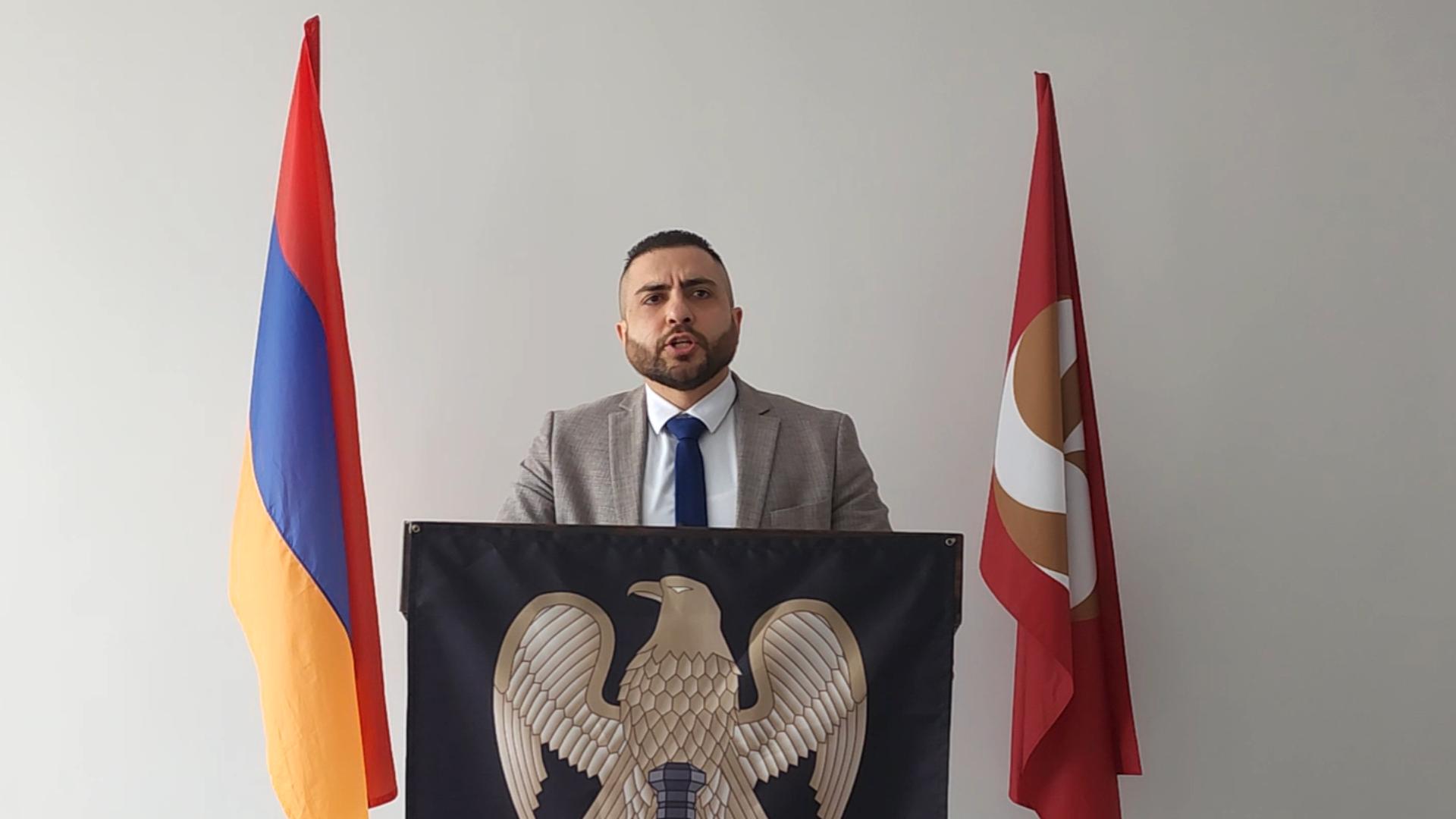
Հայկ Նազարյան - Ճառ #20 - «Հոսանք»-ի ժողովում (14-02-2026)
03:00:00 14.02.2026
Speech #20
At the meeting
It has been almost four years since Russia began its war against Ukraine. Many of our compatriots may think there is no point in us addressing this, since at first glance it seems to have little to do with Armenia. But in reality, the opposite is true. I believe we must openly state what expectations we have from the end of this war, because whether we like it or not, it will affect us. That is why we cannot ignore what is happening today in Eastern Europe if we truly want to break free from Russian colonialism and achieve real independence.
In order to attain that real independence, we must also remember the February Uprising, whose 105th anniversary we will mark in just a few days. That uprising continues to inspire us Armenian nationalists in our path of struggle, because only by keeping that memory alive can we fight for our national interests. Those events remind us that we are obliged to resist Russo-Turkish expansionism and their anti-Armenian programs. I am convinced that this wave of resistance will only grow as Russia’s failures become increasingly evident to everyone—until the final collapse of that federation.
One of the greatest myths—or rather, lies—that has harmed Armenians the most for decades is the claim that without Russia, the Turks would annihilate us. This great lie keeps us in a servile and pitiful condition, because we constantly place our hopes in the Russians, failing to understand that the more we rely on them, the more we suffer and harm ourselves. I have spoken about this before, and it would seem that after the disgraceful defeat in the treacherous 44-day war, most of our compatriots should have understood this. Yet unfortunately, a significant portion still believes this lie and the absurd notion that by becoming part of Russia we could live more safely and peacefully.
If that were truly the case, over these four years thousands of our compatriots would not have died fighting in the Russian-Ukrainian war. We have suffered more losses in that war than in the war in Artsakh five years ago—an outright tragedy, because on that Eastern European front our compatriots, in this case, truly died for nothing. We do not even mention the number of our fallen who fought for the Soviet Union in the Second World War, which can essentially be considered a second genocide. If Armenia were part of Russia today, imagine how many tens of thousands of casualties we would already have had.
If you truly believe that by joining Russia we would “save” Armenia from Turkification, you are gravely mistaken, because the truth is the complete opposite. Entering a new Union State with Russia would be the fastest and easiest way to Turkify Armenia, because under such nightmarish conditions Russians and Turks would once again divide Armenia—worse than during the 1921 Moscow and Kars treaties. That would not only deprive the Armenian nation of independent statehood, but also of any possibility of ever becoming a military-political factor.
This is how the traitorous neo-Bolsheviks envision the so-called “real” Armenia. But for us Armenian nationalists, the only real Armenia is an independent, united, powerful Armenia—unequivocally freed from the Russo-Turkish cage. An Armenia that includes not only all of Artsakh, but the majority of the Armenian Highlands, because striving for that is the yearning of our national spirit and the call of destiny.
We must deeply understand this if we want to destroy the myth that Armenia is doomed without Russia, because that belief gradually leads us to ruin. By understanding this clearly, we will conclude that Russia’s collapse would open a window of opportunity for us Armenians to build the real Armenia we envision—an opportunity we cannot afford to miss. That window will open just as it did for our freedom fighters about 35 years ago. But this time, instead of liberating only Artsakh, we will liberate all our historical lands currently within Azerbaijan, bringing the dictator of Baku and his criminal regime to their knees once and for all.
The largest country in the world by territory—also a nuclear superpower with vast resources and one of the largest armies on earth—has for nearly four years been unable to conquer comparatively small Ukraine, suffering hundreds of thousands of casualties while damaging its own economy. It is stuck in a swamp and cannot get out. Yet we are told that this same state, 85 years ago, when it was in far worse condition, supposedly defeated Nazi Germany alone—without the enormous financial, military, and strategic support of the West. That is absolute nonsense, and the Russians know it well. The Russian army’s strategy and organization are a disgrace; its only “strength” is numerical superiority in manpower and resources, and its indifference to the lives of its own soldiers. This war has revealed that Russia’s military power is based more on illusion than reality.
The Kremlin knows very well that its country is in an extremely dangerous situation. Turkey is not in a less alarming state, as its economy too declines year after year. All signs indicate that the neo-Bolshevik Russian Federation will collapse internally, just as the Soviet Union collapsed after the Soviet-Afghan war. The dying Russian Empire, which in two years will mark its 300th anniversary, will not be able to prevent the inevitable. Its final collapse will be harsher than the collapses of Tsarist Russia and the Soviet Union combined.
In any case, Russia is not currently “losing” Armenia and Azerbaijan, as many Western newspapers mistakenly claim, nor are Armenia and Azerbaijan “expelling” Russia from the region, as many immature analysts here believe. This is actually an illusion created by Russia itself, because it is in fact trying to further entrench its position in this region. Russia must convince people that it is losing influence here so that it can justify continuing its expansionist policy in the near future—under the pretext of “self-defense” against the West. This time it will attempt to deploy its troops fully into the territory of the Republic of Armenia, just as it did in Artsakh, once again presenting itself as a “peacekeeper.” To do this, the Kremlin is waiting for the right moment to give the dictator of Baku the green light to attack Armenia, so that it can then come and “save” us—just as it “saved” the Armenians of Artsakh.
Throughout human history, nearly all empires have pursued expansionist policies under the guise of “self-defense,” and Russia is no different. What better justification than claiming that the West is “snatching” Armenia and Azerbaijan away from Russia, weakening its position in its sphere of influence?
Russia will not lose its influence over the South Caucasus unless it experiences internal collapse, as happened with Tsarist Russia and the Soviet Union. Only then can such a scenario be expected. As long as post-Soviet Russia remains relatively stable, it will not allow this region to slip from its grasp so easily, because it is of vital importance to it. The simple reality is that Moscow and Ankara want to divide this region between themselves once again, as they did a hundred years ago, establishing “peace” at the expense of Armenia’s independence. To accomplish this, they will of course use their terrorist proxy state, Azerbaijan. At the center of that deal between the two predators would be the capture of Syunik by Baku, leading to Armenia’s total and final fragmentation.
Armenia’s government wants peace, as does Azerbaijan’s. The difference is that our treacherous government is ready to surrender our independence in exchange for that peace—claiming that it is thereby strengthening it—while Azerbaijan’s Armenophobic government is ready to establish its supremacy over our state in exchange for peace, stripping Armenia of sovereignty and independence. All of this benefits the Russian Empire, which has always preferred Turkish dominance in this region over the existence of an independent and powerful Armenian state. History provides us with many examples of this.
In any case, if we continue with a servile mindset and a defeatist psychology, Russia’s collapse will not automatically bring Armenia full independence. To make that a reality requires determination, dedication, and unwavering struggle from us. If we are not ready to fight and make sacrifices for our independence, nothing will save us.
We can break the Russo-Turkish-Zionist alliance against Armenia and free ourselves from the Russo-Turkish cage only if we begin preparing from this very moment for a serious struggle—against the Turks, the neo-Bolsheviks, and the traitors. When the Russian Empire begins to crack from within and collapse, that will be our signal to act.
Many think I exaggerate when I say that after the end of this Russian-Ukrainian war, the Russian Federation will most likely fragment into various large regions, just as the Soviet Union fragmented after the Soviet-Afghan war, and that serious shocks will arise in Armenia as a result—shocks that could plunge our entire system into deep crisis literally overnight, since Armenia is, unfortunately, dependent on that federation in almost every way. They especially think I exaggerate when I say that this time the Russian Empire will collapse for the third and final time.
But this is not prophecy—it is simple calculation. The Soviet-Afghan war lasted about ten years, during which the Soviet Union suffered around fifteen thousand casualties. In contrast, in this Russian-Ukrainian war, now ongoing for four years, the Russian Federation has suffered incomparably greater human losses—around one million, including, as I mentioned earlier, thousands of our compatriots living in Russia.
We must also consider that the Soviet Union was geopolitically far more weighty than today’s Russia, which faces numerous deep structural problems: declining labor force, emigration, extremely low birth rates, and economic vulnerability. There are many other social, political, and economic factors suggesting that the Russian Empire is in decline and living through its final years. Among them, its military-political failure in this war is one of the key factors.
History has repeatedly shown that before their final collapse, great empires begin to suffer military defeats. This was not only true of the Soviet Union. The Roman Empire suffered numerous defeats by Germanic tribes, the Huns, and the Persians before its fall. The Ottoman Empire gradually weakened in the 18th and 19th centuries due to military defeats against European powers. In China, the Qing dynasty lost the Opium Wars and other conflicts in the 19th century. In short, defeats and failures in war are devastating for empires, because they are extremely costly, create internal instability, and shatter the illusion of power, exposing real vulnerability. George Orwell once said, “Empires are maintained not by force, but by illusion; when the illusion disappears, the empire collapses.”
These defeats and subsequent collapses occur because before dying, empires always take a “last breath,” attempting to expand their borders further and impose their will more forcefully on other states. They organize oversized military campaigns, centralize power, harshly suppress opposition, and attempt grandiose projects.
This “last breath” of empires resembles a dying star that burns brighter before it fades. It happens when empires begin to face numerous internal problems—economic, demographic, and social. Because of these internal problems, they lose confidence in their own strength and future, and resort to extraordinary measures in an attempt to “recover.” Unable to find solutions internally, they seek “solutions” externally. It is like a person with a large ego who is actually deeply insecure, trying to assert himself through dramatic actions and grand rhetoric.
And so, the recent actions of the United States, the Russian Federation, and even China over the past few years are nothing other than the “last breath” of their dying empires. After betraying Artsakh, the Kremlin began its war in Ukraine to reclaim strategically important parts of its Soviet borders. Meanwhile, Washington under Trump, with the slogan “Make America Great Again,” seeks to acquire Greenland and perhaps even Central America and Canada. But our supposed ally Russia has no idea that its betrayal of Artsakh was in fact the beginning of its own end.
America and Russia, despite their differences, face nearly identical external and internal problems, because both became superpowers after the Second World War, when nationalism was defeated and a Zionist world order was established. Many, seeing the bold steps of Washington and the Kremlin, think they are gaining new momentum. But when they understand the “last breath” of empires, they will realize that these empires—and the corrupt world order they established—stand on the brink of collapse. Let us remember the words of the wise Roman emperor and philosopher Marcus Aurelius: “Look to the past—its changing empires that rose and fell—and you too can foresee the future.”
Thus, we live in very interesting and fateful times. We have reached a turning point where we will either definitively lose our independent statehood—and with it, our nation’s future—or write a glorious history that our heroic ancestors would honor and take pride in. Just as our freedom fighters in Mountainous Armenia and during the February Uprising resisted the Turks and the Bolsheviks, so too must we today resist Turkophilia and neo-Bolshevism with that same spirit, using all lawful means.
Their spirits look down upon us today and guide us, because the fate of our entire nation depends on people like us. Where they could not fully succeed, we will succeed, because this time history works in our favor. The time of awakening and national revolution is coming.
Against this backdrop, we Armenian nationalists must soberly assess developments and prepare from now for major regional upheavals, so that when the coming storm arrives we may become lightning—showing our compatriots the bright path through the darkness. Only in this way can we defend our national interests by founding a true Armenian national state and avoid repeating the mistakes of the past—this time fully carrying out the sacred historical mission entrusted to us by the Creator.
- Hayk Nazaryan
February 14, 2026