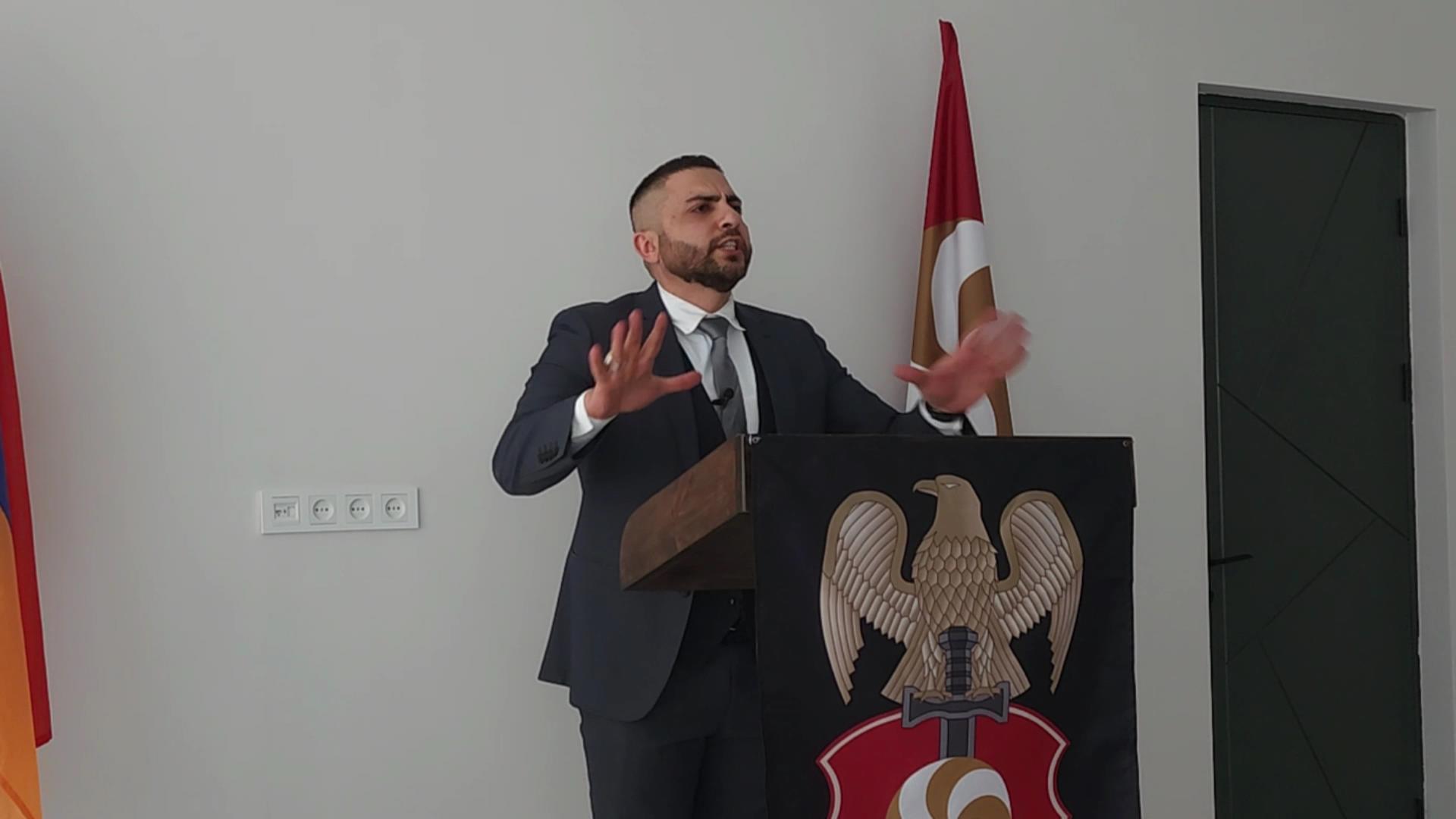
Հայկ Նազարյան - Ճառ #18 - «Հոսանք»-ի Ժողովում (17-01-2026)
03:00:00 17.01.2026
Speech #18
At the meeting
This month we marked the 140th anniversary of the birth of our Commander Garegin Nzhdeh, as well as the 93rd anniversary of the Tseghakron oaths just a few days ago. We often present ourselves as that young national political movement which not only preaches Nzhdeh’s ideas, but also revives them in the 21st century. Of course, there have been many organizations that have presented themselves under Nzhdeh’s name in order to gain credibility and show that they are supposedly patriotic or nationalist, but the overwhelming majority of them, if not all, have had absolutely no connection to nationalism and especially to Nzhdeh’s ideology.
Unfortunately, over the years those various organizations or groups have devalued and continue to devalue Nzhdeh’s ideas, because they have as much connection to Tseghakronism as we have to ballet. That is why I think it would be right today to speak a little about Nzhdeh and his struggle, so that everyone understands how we perceive all of this, and why it has such great significance for our struggle. This will also help us understand not only the importance of having a leader in our time, but also its necessity.
Over the last especially 20 years, many of us have spoken about Nzhdeh and quoted his words, delivered speeches in his honor and raised toasts, and expressed countless words of praise toward him. But I think only a very small percentage have understood Nzhdeh’s true essence and realized his uniqueness for modern Armenian history. The majority actually have a superficial understanding of who Nzhdeh really was, and by constantly glorifying his image, people think that he was a demigod or a superhuman. Yet the surprising thing is precisely that he was simply a man who could not perform miracles, regardless of the fact that he possessed a divine and superhuman will.
He was not a hero sitting on a white horse with a magic wand, as many imagine. As much as we love, respect, and revere our Prophet-Commander, we must understand that he did not appear out of thin air to save Syunik and, by doing so, also save our Fatherland from partition. He did all of this and achieved success solely through hard work, sacrifices, and organized, consistent struggle. Over the years he went from village to village, turning ordinary peasants and workers into soldiers and uniting them.
Nzhdeh showed us what an Aryan man can achieve when he has an unbreakable, indomitable will and unwavering faith in our victory. This is the main reason why, for us, Nzhdeh is not only a hero and an exemplary military and political figure, but also a measure of greatness, because he not only played an extremely large role in the sacred cause of saving our Fatherland, but also no other Armenian in modern history has served the cosmic life force—the creative process—as much as he did.
Nzhdeh, unlike our other heroes of his time, not only created a new ideology to heal our nation, but also became the embodiment of that ideology through his personal example. That is why he was not only a military figure, but more than anyone else an ideological, political, and spiritual figure. He laid the foundation of Armenian nationalism in the modern era of our history, and as I said at the beginning, our goal is to carry his work forward—continuing his struggle in the new millennium by building a national state based on ethnic values.
This is our movement’s understanding of Garegin Nzhdeh and his activity, ideas, and struggle, but in our country, as I already said, many seem to have a different understanding, because while invoking Nzhdeh’s name, they promote ideas that are completely contrary to Nzhdeh’s ideas. Having lived in Armenia for about ten years now, I have heard every kind of madness. I have seen people who simultaneously considered themselves Tseghakron, yet defended Jughashvili Stalin; who quoted Nzhdeh’s words, yet were pro-Russian or pro-Soviet; who spoke of nationalism, yet had a positive attitude toward communism, and other such absurdities. Every year I noticed such contradictions more and more, and therefore gradually realized that only a very small percentage of those in Armenia who consider themselves Nzhdehist or national truly are so. Finally, I understood that the overwhelming majority are in fact neo-Bolsheviks—under a national disguise and holding Nzhdeh’s book.
We saw the best proof of this two years ago, when we gathered at Nzhdeh’s statue to mark the 138th anniversary of his birth. Artsakh had just been completely depopulated of Armenians. The goal of our small gathering and march was not only to mark our Commander’s anniversary, but also to send a message to our external enemies and to those hostile to Armenians that in Armenia there exists a true Armenian nationalist political movement that does not accept their anti-Armenian agenda, opposes their violence, and does not tolerate their betrayals.
It was a march that shook not only Armenia, but the entire world. That message reached Baku, Ankara, Moscow, and Tel Aviv like lightning, because over the last 30 years no other march had inspired as much fear in them as ours. That message showed everyone that the Armenian nation is still vital and will not go to its knees. It showed that there is a force that will thwart all their satanic plans directed against our Fatherland.
However, a great outcry was raised in our political field and media against our gathering and march, even by many ignoramuses who consider themselves “national” or “patriotic,” simply because in front of Nzhdeh’s statue we performed the Aryan salute and shouted “Misht Hay.” Those scoundrels raised a great outcry over this, but did not utter a word when, just two months after our gathering, an action organized by a Russophile with a large mural of Putin took place near the Sardarapat Memorial. For them, performing the Aryan salute and shouting “Always Armenian” at Nzhdeh’s statue is unacceptable, while an action flattering the President of the Russian Federation at Sardarapat is not only acceptable, but even welcome. I cannot recall a better example or proof of how anti-national, anti-Armenian, and corrupt our entire political and media field is.
After those events, I very clearly understood and became convinced that in Armenia’s political arena we truly are the only nationalist political movement. And those patriotic compatriots of ours who are not neo-Bolsheviks apply Nzhdeh’s ideas and thoughts only in the cultural sphere, whereas we apply them precisely in political struggle, which is a far more important and necessary task. All analyses of our movement regarding every important internal and external issue concerning our nation are carried out through the lens of Tseghakronism. Before taking any political position, we always ask ourselves what Nzhdeh would think about this issue or what position he would take in this case, because by asking such questions we will be able to advance our struggle toward victory. This is how we continue to keep Nzhdeh’s memory alive and carry it forward in this 21st century, while the fake nationalist neo-Bolsheviks continue to discredit and desecrate his name.
Promoting Nzhdeh’s ideas in this new century is extremely important in order to show our nation the right path, but in any case we must emphasize that people follow not ideas, but the leaders who embody those ideas. That is why there are statues and pictures of Nzhdeh everywhere, but never statues or pictures dedicated to the Tseghakron ideology itself. As I have already noted, Nzhdeh was the embodiment of those ideas, and without him—the figure embodying the idea—we would not have had successes in Mountainous Armenia 105 years ago. He showed that in critical times it is important and even necessary not only to preach lofty ideas, but also to have a leader who embodies lofty ideas. He proved that ideas without a leader who carries them forward in reality have no value.
Anyone who thinks that without an honest, iron-willed, and steadfast leader we can emerge from this base and difficult situation does not understand human psychology and has learned nothing from the history of mankind. In these “peaceful” and comfortable times, falsehood reigns, and debates and “round tables” are more acceptable to the public. However, during the coming great crisis, people will forget that emptiness and will seek one decisive and uncompromising leader, because their natural instincts will awaken. As Nzhdeh said: “A true leader is often not appointed; he appears when there is a need for him, he emerges in times of danger.” In such dangerous and extreme situations, truth is able to pierce the illusion of lies and move forward.
The problem, however, is that in Armenia’s political field everyone strives to be a leader and thinks they can be a leader, without realizing that being a leader comes with extremely great responsibility and sacrifice. That is why in these relatively stable and peaceful times there is no great consolidation around one leader, especially if that leader is still young. Many guys, because of their ego, do not understand that being a follower is not only not bad or demeaning, but that in order to be a good leader, one must first and foremost be a good follower.
Before entering politics, as an unknown repatriate, I served as a contract soldier at the Tavush positions. About two years later, I volunteered for the 2020 war and served from beginning to end on the Martakert front line. Throughout my entire service—both in peacetime and in war—I carried out all my commanders’ orders without hesitation, regardless of the fact that my platoon or company commanders were younger than me. I was born, raised, received higher education, and taught at a university for three years in the United States of America, but none of that ever served as a reason for me to place myself above my commanders. There was no duty that I did not perform, regardless of how badly I felt or how sick I was. I had no complexes, because in the army I did not view myself as a separate individual, but as a part of the force, and if that force is to move correctly, then all soldiers of the force must know their duties and carry them out with honor, regardless of anything.
Everyone wants to be a leader, but not everyone wants or is ready to go through the heavy and difficult path of leadership. Everyone wants to sit on the throne, but no one wants to earn that throne through sacrifices and hard, consistent work. Yet only through that path is it possible to make the throne serve the nation, the fatherland, and statehood. Therefore, leadership is not self-proclaimed. To be a leader, a person must first and foremost prove through the example of their own life and their own unbreakable struggle that their words and ideas are not empty air, but are based on concrete steps and actions.
A nation standing on the brink of destruction cannot survive with uncertainty or half-measures. In such times, only a national leader can unite the nation, restore dignity, and make the heavy decisions necessary to put the nation back on its feet and save the Fatherland. Leadership founded on patriotism and nationalism turns sorrow into hope, indifference into action, chaos into order, and weakness into strength. Without such a leader, the nation will continue to be destroyed; with such a leader, the nation can rise from the ashes.
By fate, we once again stand before the same problem that our Sparapet stood before nearly a hundred years ago. Syunik, as well as the independent statehood of all Armenia, is once again on the brink of collapse. Therefore, more than ever, we are obliged in our time to give new breath to Nzhdeh’s ideas. The fact that a man like Nzhdeh was born in the critical times of our Fatherland was proof of Armenia’s vitality. It remains for Armenia to once again demonstrate its viability in this most critical time of our history.
Only a political struggle blessed with Nzhdeh’s decisive will and blazing spirit can cleanse our country of this neo-Bolshevik disaster and anti-Armenian phenomenon, which are leading our Fatherland toward final fragmentation and our nation toward a new genocide. We must halt this entire nation-destroying process. For this we have no alternative: standing on Nzhdeh’s shoulders, we must continue his work—for the sake of our national values, for the sake of our honor, and for the sake of our nation and sacred land.
– Hayk Nazaryan
January 17, 2026